Radioddity GM-30 GMRS Radio Range Test: How Far Can These Handhelds Really Reach?
A little over a year ago, my wife and I set out to answer a question that every prepper and outdoor enthusiast eventually asks: just how far will a handheld GMRS radio actually reach? We picked up a pair of Radioddity GM-30 GMRS (General Mobile Radio Service) handheld radios to use as our primary way to communicate around the cabin and the surrounding property, and before we relied on them for anything important, we wanted real-world proof of what they could do.
So we mapped out a route around our property that included a mix of open fields, varying elevations, and areas near power lines to simulate real interference. In this post, I’ll walk you through exactly how we tested the radios, what equipment we used, and what kind of range and clarity we actually got — plus why running your own range test matters more than trusting the specs on the box.
What is GMRS?
For anyone new to this, GMRS stands for General Mobile Radio Service. It’s a licensed radio service in the U.S. that allows for two-way communication over set channels, commonly used for family communication, off-roading, farm and ranch work, and emergency preparedness. Unlike FRS (Family Radio Service) radios you might find at a big box store, GMRS radios can legally use higher power output and external antennas, which means significantly better range — but you do need an FCC license to operate on GMRS frequencies.
The Setup: Radios, Antennas, and Base Station
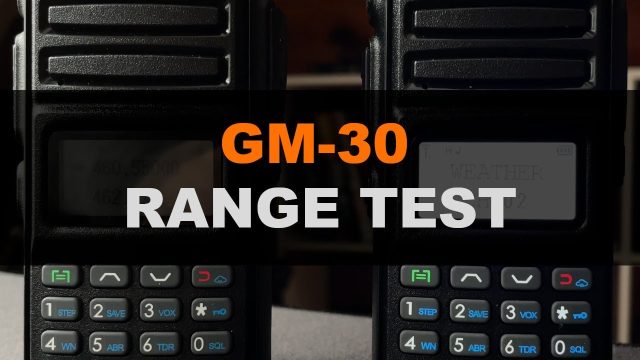
For this test, we used two identical Radioddity GM-30 GMRS handheld radios, purchased as part of a two-radio kit for about $50. That kit came with a 15.3-inch whip antenna, which we swapped in to replace the stock “stubby” antenna that ships on the radio. A longer whip antenna generally improves range and reception because it’s more efficient at radiating and picking up the radio signal, especially compared to the compact antennas that come standard on most handhelds.
It’s important to note there were no external antennas involved anywhere in this test — no antenna mounted on a vehicle, and no antenna mounted on the cabin. Our “base station” was simply one of the GM-30 radios operating from the upstairs of our log cabin, which gave us a modest elevation advantage since our home sits a bit higher than the surrounding land. My wife carried the second radio and drove/walked out to a series of checkpoints at increasing distances from the cabin.
Step 1: Establishing the Route and Checkpoints
Before starting the test, we mapped out a route around our property that intentionally included a variety of terrain and conditions — open fields with clear line of sight, wooded areas, changes in elevation, and spots near power lines, which are notorious for causing radio interference. The idea was to simulate the kind of mixed environment you’d actually encounter during a real emergency, rather than just testing in a perfect, unobstructed straight line.
We set up several checkpoints along this route. At each checkpoint, my wife would call in to the base station for a radio check, and I’d confirm whether the transmission was clear.
Step 2: Conducting the Radio Checks
At each stop, we used standard radio call signs and phonetic confirmations to check signal clarity — things like “Lima Charlie,” which is radio shorthand for “Loud and Clear.” As she moved from checkpoint to checkpoint, the transmissions stayed remarkably clear through the first several stops, even with elevation changes and obstacles between us.
At one point during the test, a transmission didn’t come through on the third call-in attempt at a given checkpoint. Rather than stop and troubleshoot, she simply continued on to the next destination, which is exactly the kind of real-world scenario you want to plan for — you won’t always get confirmation, and you need a plan for what happens next if that occurs.
Step 3: Reaching Maximum Range
Communications remained readable all the way out to checkpoint five, which put us at roughly three miles of distance between the base and the mobile radio, depending on the specific path taken and terrain in between. Beyond that point, the signal became unreliable given the obstacles in that particular direction.
The Results: What We Learned
Overall, the Radioddity GM-30 performed about as well as we expected — we were able to maintain clear communication up to approximately three miles away, even across varying elevation and terrain. That said, the real takeaway from this test is that distance alone doesn’t tell the whole story. What matters just as much, if not more, is what’s physically between the two radios. Hills, trees, buildings, and especially power lines can all degrade or completely block a signal, regardless of the rated range on the radio’s packaging.
This is exactly why I recommend that anyone buying handheld radios for emergency preparedness go out and conduct their own range test on their own property, rather than relying on manufacturer specs or reviews from someone else’s location. The last thing you want is to assume your radios will reach a certain distance, only to discover during an actual emergency that your signal drops out well before you expected it to. Knowing the real limitations of your equipment ahead of time means you can plan your communication strategy — and your checkpoints, meeting spots, or evacuation routes — accordingly.
Where to Go From Here
If you find that handheld radios alone aren’t cutting it for your property or your needs, there are several ways to extend your range. Mobile radios installed in a vehicle typically offer higher power output and can be paired with a proper external antenna. A base station radio at your home, paired with an antenna mounted as high as possible (on a roof, tower, or mast), will also significantly boost your range compared to a handheld’s built-in antenna. In general, antenna height and quality make a bigger difference in range than almost any other factor.
That said, for anyone just getting started with GMRS for emergency preparedness, a set of handheld radios like the Radioddity GM-30 is more than capable of getting the job done for most properties and situations. You just need to test them yourself and understand exactly where their limitations are before you actually need them.
Thanks for reading, and don’t forget to check out the full video test if you want to hear the radio checks for yourself!