Nagoya NA-F30G GMRS Tactical Antenna Review
How’s it going everybody? Welcome back. Today I’m reviewing a tactical antenna by Nagoya — the NA-F30G. This antenna is tuned for two different frequency ranges, which makes it a pretty unique option if you’re the “jack of all trades” type, especially if you’re into emergency preparedness (aka prepping). Instead of being a laser-focused, single-purpose antenna, the NA-F30G tries to give you the best of both worlds by covering two very different chunks of the radio spectrum.
In this review, I’ll break down exactly what those two frequency ranges are, how the antenna’s folding design lets you switch between them, and why I think this makes it one of the smartest additions to a go-bag or bug-out setup — even if it’s not the most “optimized” antenna out there for pure GMRS use.
What Frequencies Does the NA-F30G Cover?
The NA-F30G is tuned for two distinct frequency ranges. The first range sits between 155 and 165 MHz, which falls into the VHF (Very High Frequency) band. The second range is centered around 465 MHz, plus or minus, which falls into the UHF (Ultra High Frequency) band.
For context, GMRS (General Mobile Radio Service) operates on 462 MHz and 467 MHz, with the 467 MHz range typically used when you’re transmitting through a repeater (a station that receives and re-broadcasts your signal to extend your range). So right out of the gate, you can see this antenna was designed with GMRS in mind — but it doesn’t stop there.
The Dual-Purpose Design: Extended vs. Folded
What makes this antenna special is its physical design. You can unfold the NA-F30G to its full 30-inch length, and when you do, you get roughly a quarter-wave antenna for those lower VHF frequencies I mentioned — the 155 to 165 MHz range. A quarter-wave antenna is simply an antenna whose length is matched to one-quarter of the wavelength of the frequency it’s designed to receive or transmit, which generally improves performance for that specific range.
Practically speaking, this means that when the antenna is fully extended, you’ll be able to pick up NOAA emergency weather alerts (broadcast around 162 MHz) much more effectively than you would with a traditional 15-inch whip antenna or one of those short, stubby antennas that come stock on a lot of handheld radios.
Now, when you fold the antenna down to its collapsed state, it transforms into a UHF antenna tuned for around 465 MHz — right in the sweet spot between GMRS’s 462 MHz and 467 MHz frequencies. This means that when folded, you’re getting solid, balanced performance on both the standard GMRS transmit frequency and the repeater frequency.
So, in short: unfolded, you get better VHF/NOAA weather reception. Folded, you get solid GMRS performance. It’s a true two-in-one design.
Why This Matters for Preppers and Go-Bags
This dual-purpose functionality is exactly why I like this antenna so much for emergency preparedness. If I’m heading somewhere unfamiliar, responding to some kind of emergency, or just packing my go-bag, this is the antenna I’m grabbing. Being able to extend it to pick up VHF bands — which operate at lower frequencies than the UHF band GMRS uses — gives me a lot more flexibility in situations where I don’t know exactly what I’ll need.
Real-World Setup
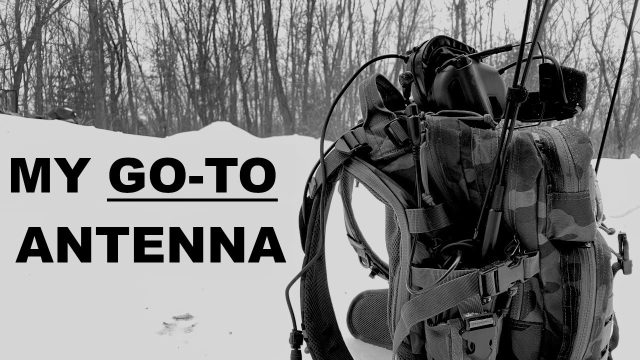
In my own setup, I’ve got this antenna mounted on my Baofeng UV9G handheld radio. That radio sits in a radio pouch attached to my daypack (or go-pack/assault pack, whatever you want to call it). Since the radio itself is tucked away, I use an earpiece with a push-to-talk (PTT) system to communicate, rather than reaching for the radio directly every time I need to talk.
Compatibility Notes
One important thing to mention: this antenna will not work with some radios — specifically the Baofeng GM-30. However, it does work fine with the GM-30 Pro and Plus editions. Outside of that, I haven’t come across a Baofeng GMRS radio yet that this antenna doesn’t work with, so for the most part, you should be good to go if you’re running Baofeng gear.
Managing Expectations: It’s Not a Perfectly Optimized GMRS Antenna
I do want to set realistic expectations here. This antenna was not designed to be perfectly optimized for GMRS alone. It was built to be a middle-ground, dual-purpose tool — good for both lower VHF frequencies and the higher UHF GMRS range, but not a specialist in either one.
You may come across other reviewers who hook this antenna up to an SWR (Standing Wave Ratio) meter — a tool used to measure how efficiently an antenna is transmitting a signal — and complain that it doesn’t hit a perfect 1.0 reading for GMRS. That’s missing the point. This antenna was never meant to be a dedicated, fully optimized GMRS antenna. When you choose a dual-purpose antenna, you’re always going to sacrifice a little bit of peak performance in exchange for versatility. That’s simply the trade-off.
If you want a highly optimized GMRS-only antenna, those exist too, and they’ll perform great for that single purpose — you might squeeze out a bit of extra range. But that brings up a bigger point: terrain matters far more than minor antenna optimization.
Terrain Matters More Than a Perfect SWR Reading
As long as your antenna is in the right ballpark for GMRS frequencies, terrain is going to have a much bigger impact on your communication range and quality than a slightly-off SWR reading. This isn’t just theory — my wife and I have tested numerous radios in a wide variety of real-world terrains on this channel, communicating at distances of two, three, and even four miles apart, not just casually chatting a few hundred feet apart in the backyard.
From that experience, I can confidently say you don’t need an ultra-optimized antenna for most real-world use. That’s exactly why I prefer a dual-purpose antenna like the NA-F30G for situations where I need flexibility.
That said, if I’m just hanging around the cabin chatting with people nearby, I’ll switch to a 6-inch quarter-wave antenna, which is very optimized specifically for GMRS. In that scenario, I’m not heading into the unknown or preparing for an emergency, so a dedicated antenna makes more sense. It really comes down to your specific use case.
You Can’t Have Both at Once
One limitation to keep in mind: you can technically transmit on GMRS while the antenna is unfolded, but performance won’t be nearly as good as when it’s folded. So you do have to choose one configuration or the other depending on your situation.
For example, if you’re back at base or camp with everyone accounted for, you can pop the antenna open, set it in a small antenna cradle or stand, and scan the NOAA weather channels. Most GMRS radios come pre-programmed with 10 NOAA weather frequencies for exactly this purpose — just scan through them and you’re set. Then, when it’s time to head out into the field, simply fold the antenna back down, and you’re ready for solid GMRS communication on the move.
Final Thoughts
Overall, I think the Nagoya NA-F30G is a solid buy for the price. I’ve seen it listed anywhere from around $25 on sale up to $50, which is quite reasonable in today’s market. Even though it’s not a fully optimized, dedicated GMRS antenna, the flexibility it offers — especially for prepping, emergency situations, or go-bag setups — makes it well worth the investment.
Thanks for watching, and I’ll see you in the next one.